
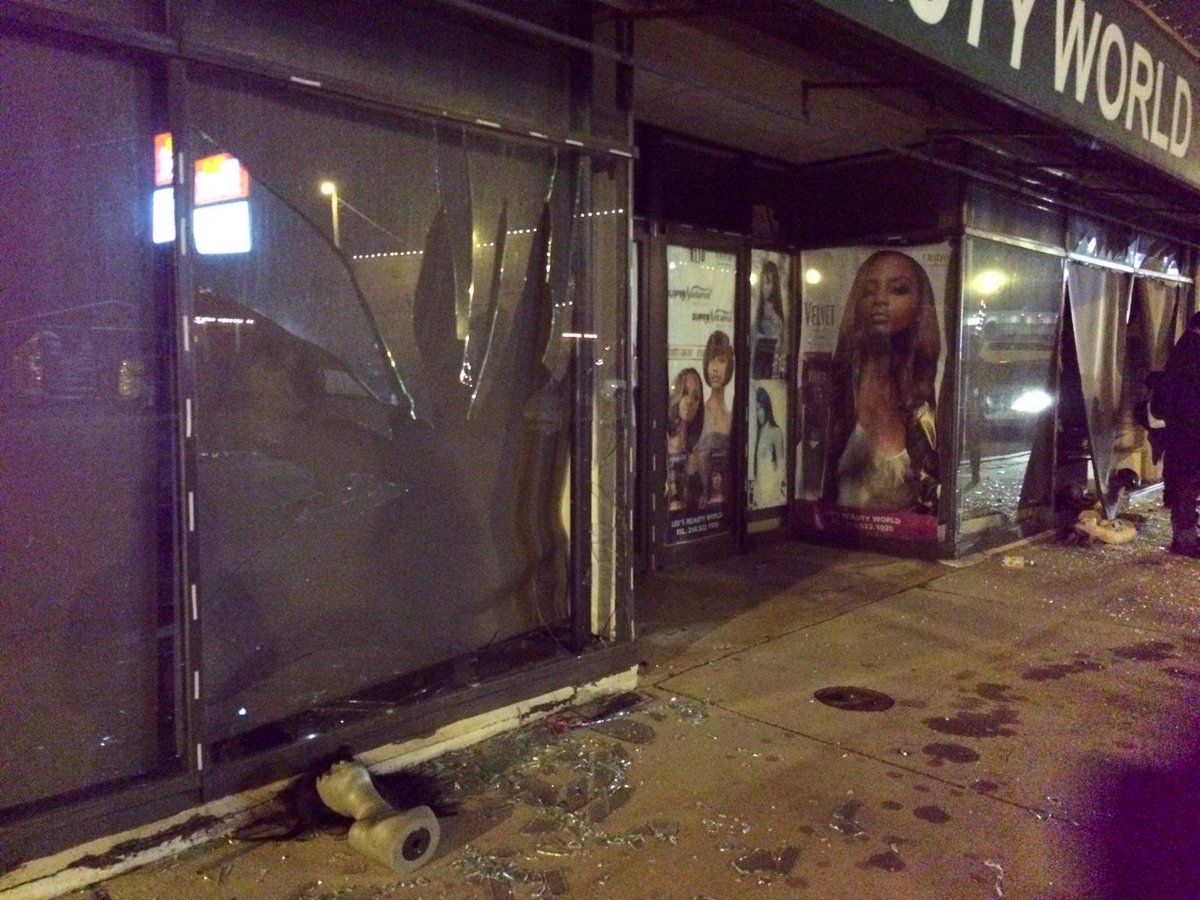
More than a dozen buildings charred, set ablaze in a wave of fury. Stores -- many owned by locals -- looted, with shattered glass covering the asphalt outside. Shell casings on the ground, having been fired by unknown shooters.
Welcome to Ferguson, Missouri.
This is what Tuesday
looked like in Ferguson, hours after an eruption of rage over a grand
jury's decision not to indict police Officer Darren Wilson in the
shooting death of 18-year-old Michael Brown.
Many of those who took to
the streets late Monday into Tuesday to vent what they say is police
violence and racial injustice -- rooted in the fact that Brown was black
and Wilson is white -- did so peacefully. Others did not, hurling
bottles, batteries and rocks at police.
An entire row of
businesses on West Florissant Avenue, a major thoroughfare, was engulfed
in flames. Police cars and a row of vehicles at a nearby dealership
were turned into fireballs. There were so many infernos that
firefighters couldn't get to every one.
There were also reports
of gunshots: St. Louis County Police Chief Jon Belmar heard at least 100
through the night, though Missouri State Highway Patrol Capt. Ron
Johnson insisted no bullets were fired by police. CNN's Sara Sidner was
struck in the head with a bottle.
"What we saw tonight was much worse than what we saw any night in August," the St. Louis County police said on Facebook,
referring to the days immediately after Brown's death. "Bricks were
thrown at police officers, two St. Louis County police cars were set on
fire and police seized an automatic weapon."
Authorities responded with round after round of tear gas, as well as shooting bean bags into the crowds.
Six people were treated
and released with minor injuries between 10 p.m. Monday and 4 a.m.
Tuesday at Christian Hospital in St. Louis, hospital spokesman Bret
Berigan said. There were no known serious injuries -- either to citizens
or police officers -- according to Belmar.
Police in Ferguson ended
up making at least 61 arrests on charges ranging from unlawful assembly
to burglary to unlawful possession of a firearm to arson.
By mid-Tuesday morning,
the plazas were empty. Even the scene outside the police department --
where Missouri National Guard members were to provide security, under
orders of Gov. Jay Nixon -- was calm.
But no one was under the belief that the tensions, or the threats of more unrest, were gone.
"People here have a real grudge against the police," said one protester, Demetric Whitlock. "It's not going away."
Protesters turn out nationwide
It wasn't just that way in Ferguson.
Twelve miles south in
St. Louis, Police Chief Sam Dotson said windows of businesses located
across the street from a protest gathering spot were smashed and 21
people were arrested on felony accusations, including illicit gun
possession. But no one was shot.
"What we saw last night
is the criminals were using the cover of the organized protests to do
their criminal activity," Dotson said.
News about the grand
jury's decision not to indict Wilson also spread quickly nationwide,
spurring others to turn out for spontaneous rallies in support of
Brown's family and against what they characterized as unnecessary force
by some police against citizens, especially African-Americans.
Some laid down on the
street outside the White House in protest. In New York's Union Square,
scores held up a huge, lit-up sign that read, "Black lives matter." More
protesters took their message to the streets of Seattle, Washington,
and Oakland, California.
Others will get their
chance to express their views in more than 100 pro-Brown family vigils
and gatherings in cities big and small -- from Los Angeles to Bangor,
Maine -- planned nationwide on Tuesday.
There is the chance that, in Ferguson or any of those places, violence could flare between protesters and police.
The idea of more
destruction and more violence pains the Rev. Traci Blackmon, a pastor at
Ferguson's Christ the King United Church of Christ, who backs Brown's
family but not what's happening to their city.
"I hurt for all the
people in my community, and I hurt for the many young people who did
everything they could ... to make sure that last night was not violent
and make sure their voices were heard," she said. "And unfortunately,
the pain and the rage of a few have made a different narrative."
'Exhaustive review'
All of this unrest, all
of this tension dates to August 9, when Brown and a friend were walking
down the middle of a Ferguson street.
What happened next --
from the shooting, to the failure to immediately charge Wilson in
Brown's death, to the at-times violent clashes between authorities and
Brown family supporters -- turned Ferguson from a largely unknown St.
Louis suburb to the center of a national debate over race, law
enforcement and the interaction of the two.
The basic facts have never been disputed, that Wilson shot Brown.
But exactly how and why
that happened is hotly disputed. Grand jury testimony released late
Monday offered little resolution, with Wilson's version contradicting
the accounts offered by some witnesses.
The St. Louis County
grand jury of nine white and three black members got a lot of
information -- meeting 25 times, during which they heard from 60
witnesses and three medical examiners in 70 hours of testimony.
The grand jurors'
mission was never to convict Wilson. Rather, it was to decide whether
there was reason enough to charge him with a crime -- either
first-degree murder, second-degree murder, voluntary manslaughter and
involuntary manslaughter. They also could have added a charge of armed
criminal action. If at least nine of the 12 grand jurors had voted that
there was enough to proceed with charges, Wilson would have stood trial.


Post a Comment